Trip prep
What to Pack for Iceland in Winter
The suitcase that actually works between October and April, written by people who see every week what…
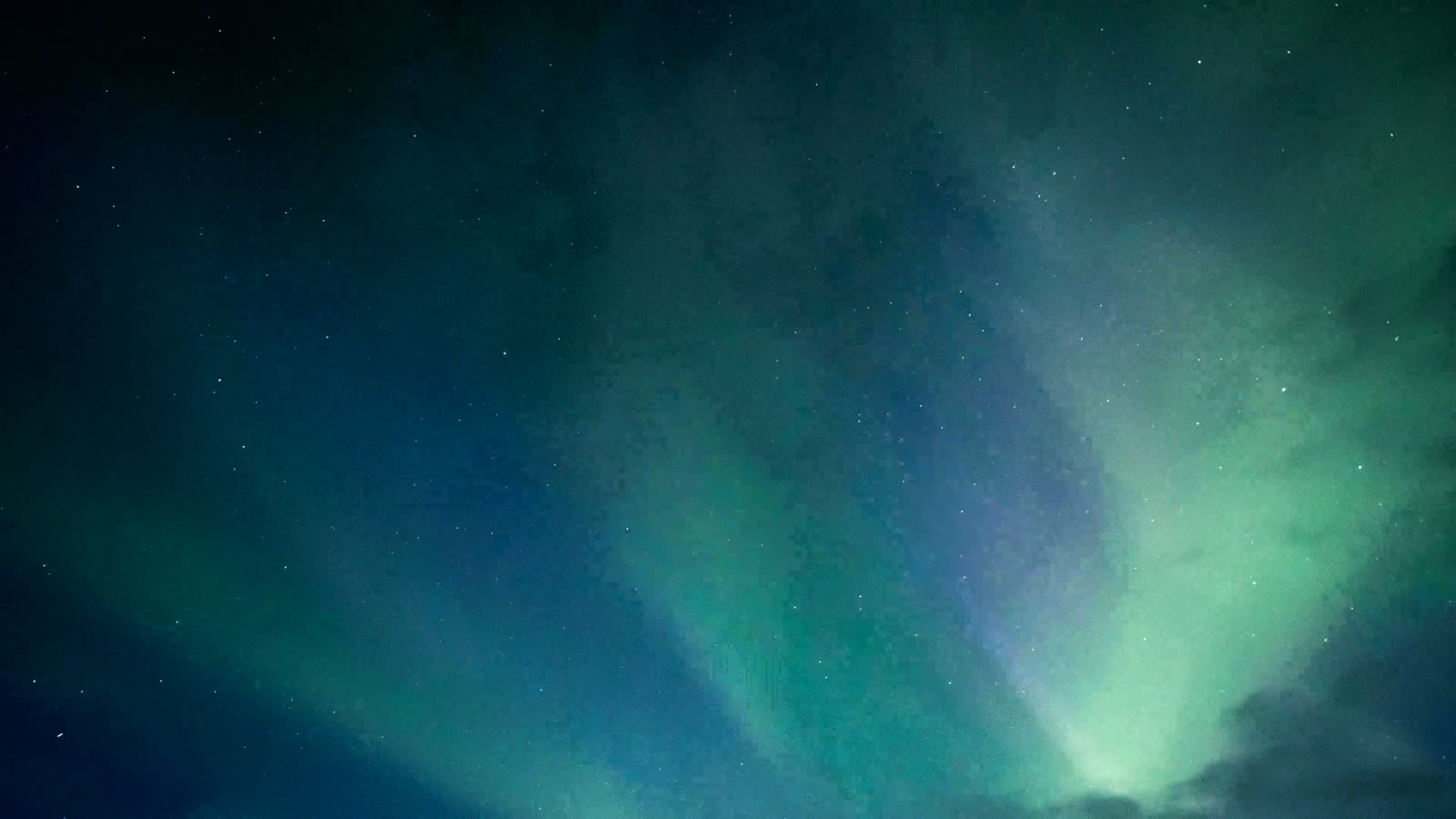
The season, the hours, the KP index, the two maps we actually check before driving out, and why February is the month we recommend most. No impossible promises.
We will say it first, because almost nobody does: no one can guarantee you an aurora. Not us, not a ten-year-old agency, not the most expensive hotel in Reykjavík. The aurora depends on two things no human controls — the sun throwing particles at the Earth, and the sky above your head being clear.
What you can do is play the odds well. And the odds in Iceland are, simply, among the best on the planet.
The season runs from early September to mid-April. It isn't that auroras "appear" in September — it's that from then on the nights are finally dark enough to see one. There is as much aurora in June as in January, but the midnight sun erases it completely.
| Month | Usable hours of darkness | Notes |
|---|---|---|
| September | 6–8 h | Summer roads still open, good balance |
| October | 9–11 h | Long nights, changeable weather |
| November | 13–15 h | Very dark, very few travellers |
| December | 16–18 h | Maximum darkness, maximum atmosphere |
| January | 15–17 h | Dark and cold, ice caves open |
| February | 12–14 h | The month with the most clear-sky departures |
| March | 9–11 h | Equinox: high geomagnetic activity |
| April | 5–7 h | Over by mid-month |
If you can only come once and you are coming for the aurora, come in February or March. Around the equinoxes (late March, late September) the link between the solar and terrestrial magnetic fields is more efficient — the Russell-McPherron effect. Statistically there are more geomagnetic storms in those weeks.
The Sun runs on an eleven-year activity cycle. Solar cycle 25 peaked in the middle of this decade, and the years just after a peak tend to produce some of the strongest geomagnetic storms of the whole cycle. In practice: the next few winters are the best you will get until well into the 2030s.
When we decide whether tonight is worth driving out for, we look at exactly two things:
Rule of thumb: solar activity decides whether there is an aurora. Clouds decide whether you see it. The second one wins almost every time.
That is why a small-group aurora hunt beats sitting in your hotel hoping: we drive toward the hole in the cloud map. Sometimes that means north, sometimes east, sometimes across to the Reykjanes peninsula. A sixty-seat coach does not do that. A ten-seat van does.
KP measures the disturbance of Earth's magnetic field on a 0–9 scale. Iceland sits so far north, right under the auroral oval, that KP 2 is already enough the moment the sky opens. You do not need KP 5. If a blog tells you to wait for KP 5, that blog was written for Scotland or southern Norway, not for Iceland.
Away from light pollution, with a clear view north. The places we usually drive to:
What does not work: the hotel garden in central Reykjavík. Too much light. You will see it, but pale.
With a recent phone, night mode, and the handset braced against something solid, you already get a decent shot. With a camera:
And the advice we give in the van every time: watch the aurora with your eyes for the first five minutes. People spend the whole show behind a screen and then don't remember seeing it.
If we drive out and the aurora refuses to appear, you get a guaranteed second outing at no extra cost. That is not a favour, it is the minimum: we sold you a probability, not a product.
With a single night, the real odds of seeing an aurora in season are around 30–40%. With three nights it rises above 70%. With five or more, it is unusual not to see them. If your trip is short, prioritise: book the aurora hunt on your first free night, not your last, so you have room to repeat.
No. The activity is the same, but between late April and mid-August the sky never gets dark enough. The visible season runs September to April.
It helps, but it is not decisive. A strong aurora beats a full moon easily. Clouds matter far more than the moon.
It can be a faint arc for two hours or a three-minute explosion. That is why hunts run four hours — you have to be outside when it happens.
Between 0 and −10 °C in winter, with wind. It is not your body that freezes, it is fingers and toes: thin gloves under thick ones, and wool socks.
Small groups, bilingual guides, free cancellation.
The suitcase that actually works between October and April, written by people who see every week what…
Daylight hours, aurora odds, which roads are open and how busy it gets.
Iceland is expensive and we are not going to pretend otherwise.
Tell us the dates and how many you are. Plan and price back today.